How to Light the Menorah
A step-by-step guide to lighting the Chanukah menorah: what you need, where to place it, when to light, the blessings, the order of the lights, and Friday and Saturday night.
On this page
Chanukah 5787: Friday, December 4 to Saturday, December 12, 2026
The first light is kindled on Friday, December 4, before the Shabbos candles; Chanukah ends at nightfall on Saturday, December 12.
- 1FridayDecember 4 · 1 lightBefore Shabbos candles
- 2Saturday nightDecember 5 · 2 lightsAfter Havdalah
- 3SundayDecember 6 · 3 lightsAfter sunset
- 4MondayDecember 7 · 4 lightsAfter sunset
- 5TuesdayDecember 8 · 5 lightsAfter sunset
- 6WednesdayDecember 9 · 6 lightsAfter sunset
- 7ThursdayDecember 10 · 7 lightsAfter sunset
- 8FridayDecember 11 · 8 lightsBefore Shabbos candles
How to light
- When. By Chabad custom, right after sunset. On Friday, before the Shabbos candles; on Saturday night, after Shabbos ends, with Havdalah first at home.
- Set up. The first night's light stands at the far right as you face the menorah. Each night, add one more to its left.
- Shamash. Light the shamash and hold it. Say the blessings, then begin.
- Light. Kindle the newest light first, the one furthest left, then the others toward the right.
- After. Put the shamash back in its place, higher than the others, and say Haneiros Halalu. The lights burn at least fifty minutes, and are not used for their light.
On each of the eight nights of Chanukah, lights are kindled at home: one on the first night, and one more each night, until eight lights burn on the last night. This guide follows the halacha as set out by the Badatz of Crown Heights and in Rabbi Yaakov Goldstein’s Shulchan Aruch HaRav guides. Where a practice is a Chabad custom, it says so.
What You Will Need
- A menorah with eight lights in a straight row, all at the same height, with a separate place for the shamash. Any kosher menorah will do; a beautiful one, ideally of metal, honours the mitzvah. The Rebbe Melech HaMoshiach encouraged menorahs with straight diagonal branches, the form of the menorah of the Beis Hamikdash as drawn by the Rambam.
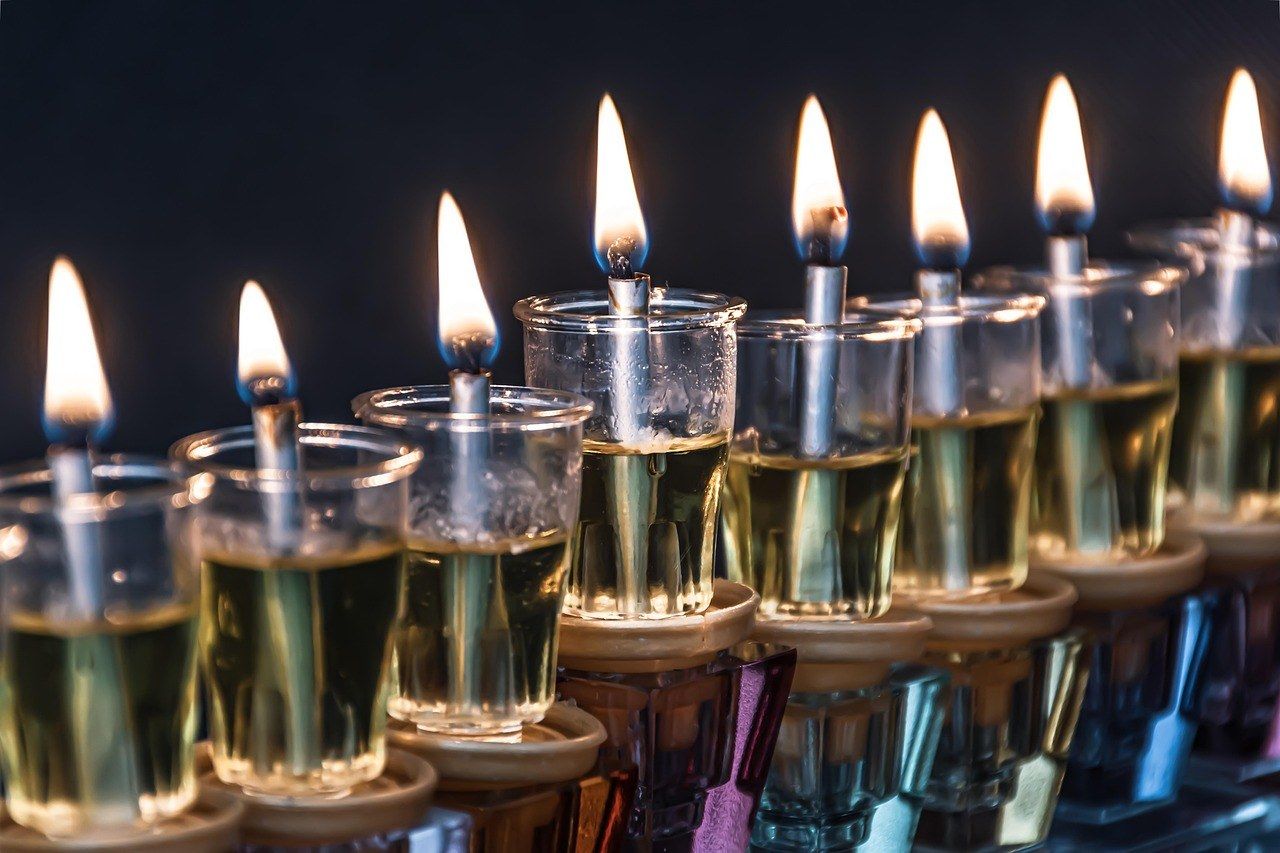
- Olive oil and cotton wicks. Halacha prefers olive oil, the fuel of the original miracle. Other oils and wax candles are also valid. All the lights on one menorah should use the same fuel. Electric lights and wickless candles do not fulfil the mitzvah.
- A shamash, the “servant” light used to kindle the others. Chabad custom is a beeswax candle.
- Enough fuel for at least fifty minutes. The halachic minimum is that the lights burn until half an hour after nightfall; Chabad custom is to fill them for at least fifty minutes. The small coloured candles sold in boxes are made to burn about half an hour, and often burn out sooner.
- A chair or small table to stand the menorah on.
Where to Place the Menorah
- Halacha: the lights stand within a tefach (about three inches) of a doorway, on the left side, opposite the mezuzah, so that one is surrounded by mitzvos. If the doorway has no mezuzah, the menorah goes on the right.
- Chabad custom: the menorah stands inside the house, within the actual space of a doorway to a room, against the left doorpost, on a chair or similar, and not on a windowsill. The direction the branches face does not matter. Many other communities place the menorah in a window facing the street.
- Height: the lights should be at least three tefachim (about ten inches) from the floor and preferably not above ten (about thirty-one inches). Chabad custom is not to be particular within that range.
- Choose a room where the family spends time, out of any draught, and safe from children and curtains.
See Where to Place the Menorah for the details.
When to Light
- Chabad custom: light at home right after sunset, between Minchah and Maariv, before the stars come out. Many others light at nightfall.
- If you could not light on time, you may light later in the night with the blessings, as long as other members of the household are awake. Once dawn comes, that night’s lighting is lost, but you carry on with the right number on the following nights.
- Do not start a meal or a time-consuming task in the half hour before lighting. A light snack is allowed.
- Friday and Saturday night are different: see below.
The Blessings
Gather the family. Light the shamash first and hold it in your right hand (left-handed people use the left). Standing, say the blessings, and only then begin lighting.
- Baruch atah Ado-noi Elo-heinu Melech ha’olam, asher kid’shanu b’mitzvosav v’tzivanu l’hadlik ner Chanukah. “Blessed are You, L-rd our G-d, King of the universe, who made us holy with His commandments and commanded us to kindle the Chanukah light.”
- Baruch atah Ado-noi Elo-heinu Melech ha’olam, she’asah nissim la’avoseinu bayamim hahem bizman hazeh. “Blessed are You … who did miracles for our fathers in those days, at this time.”
- On the first night only (or the first time you light this Chanukah): Baruch atah Ado-noi Elo-heinu Melech ha’olam, shehecheyanu v’kiy’manu v’higi’anu lizman hazeh. “Blessed are You … who has kept us alive, sustained us and brought us to this time.”
The Chabad wording of the first blessing ends l’hadlik ner Chanukah, as in the Alter Rebbe’s Siddur. The Hebrew text is on The Chanukah Blessings.
Do not speak between the blessings and the lighting, not even about the lighting, unless you must.
Lighting the Menorah
- First night: set one light at the far right of the menorah, as you face it, and light it.
- Each following night: add one light to the left of the previous night’s lights. Light the newest one first, the one furthest left, and continue toward the right.
- Hold the shamash to each wick until most of it has caught.
- Return the shamash to its place, apart from the other lights and higher than them.
- After all the lights are burning, say or sing Haneiros Halalu, “These lights we kindle …”.
- Do not light one Chanukah light from another; always use the shamash.
After Lighting
- It is customary to stay near the lights for about half an hour. The Rebbe Rashab used to sit by them and learn Torah.
- The Chanukah lights may not be used for any purpose, not even for reading. Keep another light on in the room.
- It is a custom for women not to do household work, such as sewing, laundry and ironing, while the lights burn their required time.
- If a light goes out within the first half hour, relight it without a blessing.
- Never leave burning lights unattended or within reach of children.
- This is a good time for Chanukah gelt, songs and stories.
On Friday Afternoon
The Chanukah lights are lit before the Shabbos candles, because once Shabbos begins no fire may be lit. Use larger candles or extra oil so that they burn until at least half an hour after nightfall, which by Chabad custom means at least fifty minutes after sunset. Since the menorah is lit before sunset, that is well over an hour of burning. Minchah is davened early, before lighting; if there is no early minyan, light first and then daven Minchah with the regular minyan. If a light goes out before Shabbos begins, it may be relit, by someone who has not yet accepted Shabbos. Once Shabbos has begun, the menorah may not be touched, moved or relit until Shabbos is over. A woman who has already lit Shabbos candles may not light the menorah herself; someone who has not yet accepted Shabbos can light for her.
On Motzei Shabbos
Wait until Shabbos is over and do not light a moment early. In shul the menorah is lit before Havdalah. At home, the general custom and the Chabad custom are to say Havdalah first and then light the menorah. V’yiten lecha is said after the lighting.
This Year
In 5787, Chanukah begins on Friday afternoon, 4 December 2026, when the first light is kindled before the Shabbos candles. The second light is kindled on Saturday night, 5 December, after Havdalah. The eighth and last light is again kindled on a Friday, 11 December, before Shabbos, and Chanukah ends at nightfall on Saturday, 12 December. Check your local candle-lighting time each Friday.
Questions
I forgot to say the blessings and lit the lights. What now? If some lights are still unlit, say the blessings and light the rest. If all are lit, say only the second blessing (and on the first night Shehecheyanu), not the first.
I spoke between the blessing and the lighting. If you had not yet lit any light, repeat the blessings. If you had already lit one light, carry on; nothing is repeated.
I lit one light on the second night instead of two. Light the missing one, without a blessing, as soon as you notice.
I lit too many. You have fulfilled the mitzvah. If you can, move the extra lights away from the menorah.
The candles went out before the half hour. Relight them without a blessing, somewhere they will not go out again.
I put in too little oil. Some authorities hold the lighting does not count. Put the lights out, add enough oil, and light again without the blessings.
I said the blessing for Shabbos candles by mistake. If you correct yourself immediately, say l’hadlik ner Chanukah; if more time passed, say the blessing again.
I said Haneiros Halalu before lighting. Nothing needs to be repeated.
Can my young child say the blessings for the family? A child who has not yet reached the age of education cannot light for adults; an adult should repeat the blessings and light. If an older child said them, an adult relights without the blessings. Each case has details, so ask.
I will not be able to light at all tonight. If you see lit Chanukah lights, say she’asah nissim (and on the first night Shehecheyanu).
For any question about your own situation, ask your local Chabad rabbi or asktherav.com.
For a question about your own home or situation, ask your local Chabad rabbi, or write to AskTheRav.
Sources
- Rabbi Yosef Yeshaya Braun, Badatz of Crown Heights, Day-to-Day Halachic Guide: Chanukah 5786.
- Shulchan Aruch HaRav (shulchanaruchharav.com), Chanukah Halacha, Chapter 3: The Chanukah candles.
- Sichos in English, Chanukah: Customs (from Sefer HaMinhagim).
- Rabbi Moshe Bogomilsky, Sichos in English, Vedibarta Bam: Dinim, Menorah Lighting.
- Rabbi Y.Y. Shagalov, Living With Moshiach, Your Chanukah Guide (Living With Moshiach, Vayeishev 5760).
Based on the Badatz of Crown Heights Day-to-Day Guide, Rabbi Yaakov Goldstein's Shulchan Aruch HaRav guides and Sefer HaMinhagim.
More on lighting the menorah
The Chanukah Blessings
The three blessings over the Chanukah lights in Hebrew (Chabad wording), with transliteration, translation, and what to do if a blessing is missed.
Where to Place the Menorah
Doorway or window, left side or right, how high and which room: where the Chanukah menorah goes, with the halacha, the general custom and the Chabad custom.
When to Light the Menorah
The right time to light the Chanukah menorah, the earliest and latest times, what to do if you are late, Friday and Saturday night, and this year's nights and dates.
Shabbos Chanukah
Lighting the menorah before Shabbos on Friday and after Havdalah on Saturday night, the menorah during Shabbos, prayers and Torah readings, dreidel and gelt on Shabbos, and this year's two Shabbosos of Chanukah.
Olive Oil and Candles
Which fuel and wicks to use for the Chanukah lights, why olive oil is best, how long the lights must burn, what to buy, and what to do with leftover oil after Chanukah.