Tales of the Chanukah Lights
While everyone else plays dreidel, little Chaim sits down beside the menorah, and the first Chanukah light begins to talk. Each night, one more light tells him one more story.
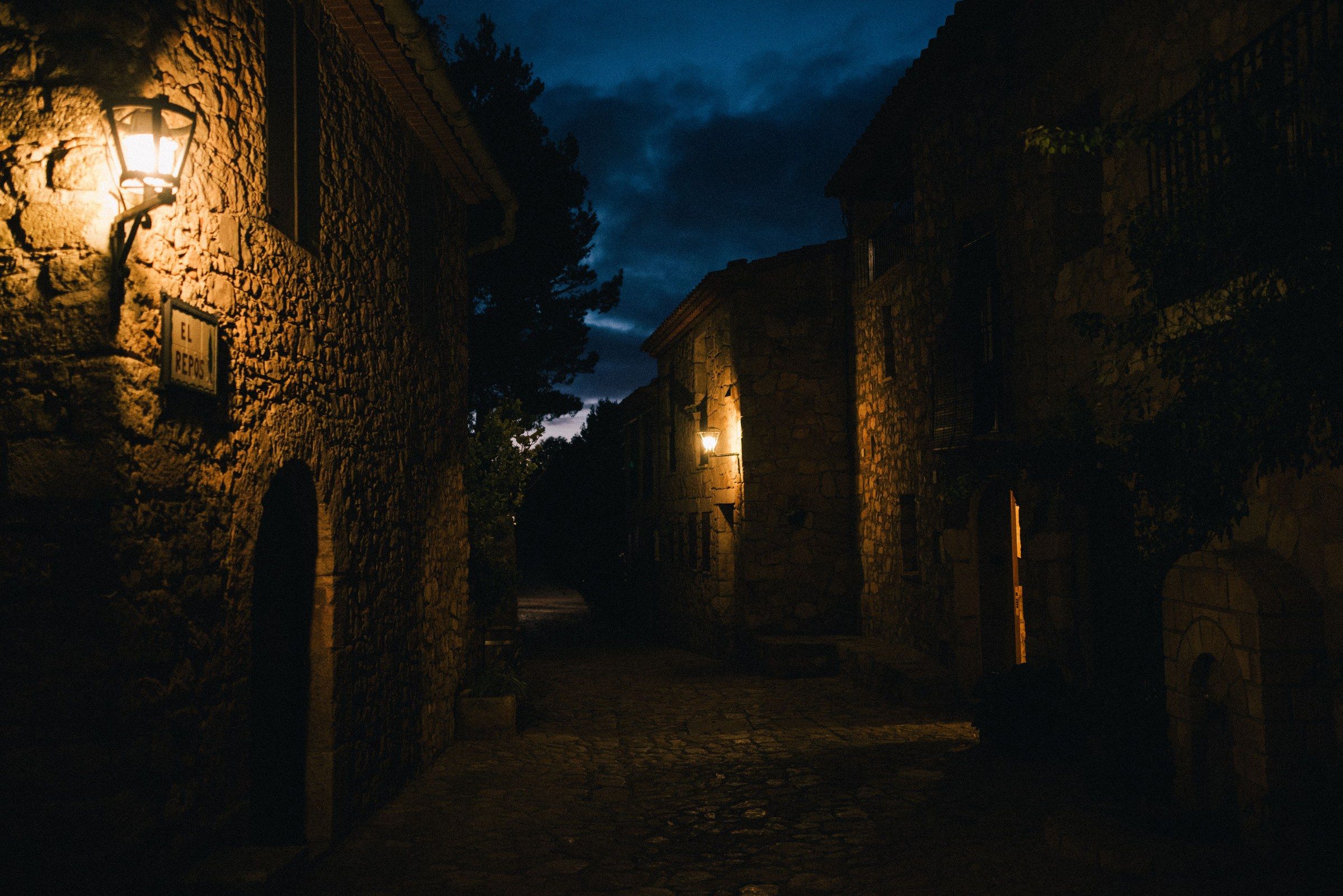
The first Chanukah light was burning, small and bright, on the windowsill. Father had sat down with the children for a game of dreidel, and the whole family was so busy with it that nobody looked at the menorah at all.
The dreidel spun and fell, shin, put one in, gimmel, take the pot! Little Chaim grew tired of the game. He pulled a chair up to the menorah and sat watching the little flame with his bright blue eyes.
The flame flickered, and bowed. “A happy Chanukah!” it said.
Chaim was so surprised that all he could do was nod. “I didn’t know Chanukah lights could talk,” he whispered.
“Oh yes. Chanukah lights can talk, and tell wonderful stories. Not many children know it. I’m glad you came to keep me company. I only come once a year, you know.”
“But we’re not allowed to use your light,” said Chaim. “We’re only allowed to look at you and think.”
“Exactly! So sit beside me and think, and listen. Would you like a story?”
“Yes, please!”
The first light
“Long ago, the Greek king Antiochus ruled the Land of Israel, and he wanted the Jews to stop keeping the Torah and to bow to idols. Terrible days came. But the Jews decided they would sooner die than give up their faith. Even boys no bigger than you were brave enough to say no to the king. And G-d said: My children have suffered enough. I will save them.
“The first to stand up to the king was an old man, weak in body and a giant in spirit. His name was Matisyahu. He lived in the quiet village of Modi’in with his five sons. When the king’s officer came to make the Jews of Modi’in worship an idol, old Matisyahu grabbed the officer’s sword and struck him down. ‘Whoever is for G-d, follow me!’ he cried, and his sons and neighbours drove off the soldiers.
“Matisyahu and his followers went up into the hills, and every day more Jews came to join them. When he felt his last day was near, he gathered them together. ‘Let my son Yehudah lead you,’ he said. ‘Even if they are many and you are few, do not be afraid. Remember Avraham, who would rather be thrown into a fire than turn away from G-d. Remember Eliyahu the prophet, who stood alone. He who answered them will answer you.’”
The little flame was getting lower. “My oil is nearly gone,” it said. “Come back tomorrow!”
The second light
The next day was Friday. Chaim got ready for Shabbos early, so that he would be there the moment the lights were lit. He watched his father light two Chanukah lights, and his mother light the Shabbos candles, and then he pulled up his chair.
“Good Shabbos, and happy Chanukah!” said the first light. “This is my little sister.”
“Hello,” said the second light, with a bow. “Shall I tell you what Yehudah the Maccabee did?
“Yehudah’s soldiers were very few. So they hid in caves, and attacked the enemy from behind, or in the middle of the night, and each time they won. King Antiochus was furious. He sent his best general with a huge army of soldiers, horses and chariots.
“‘They trust in their chariots,’ Yehudah told his men, ‘but we come in the Name of G-d.’ They blew their trumpets and charged. When the enemy saw Yehudah at the front, shining like an angel, they panicked and ran.
“Yehudah went straight to Yerushalayim to the Beis Hamikdash. What a sad sight! Everything was spoiled and made impure. For a moment the soldiers just stood and cried. ‘No time for crying!’ said Yehudah. ‘Let’s clean it and make it holy again!’
“When it was clean, they wanted to light the Menorah. But all the oil had been made impure. They searched and searched, and found one little jar of oil still sealed with the High Priest’s seal. They lit the Menorah on the 25th of Kislev, singing praises to G-d. And the oil that should have lasted one day lasted eight, until new pure oil was ready.”
“Now run along to shul,” said the second light. “See you tomorrow!”
The third light
“I will tell you about Yehudah’s brother Elazar,” said the third light.
“After Antiochus died, his son became king, and he was no better. He sent an enormous army: a hundred thousand foot soldiers, twenty thousand horsemen and thirty-two war elephants in shining armour, so bright in the sun that they dazzled the eyes for miles.
“Yehudah’s men prayed, and fought bravely. In the battle, Elazar noticed one elephant dressed more grandly than the rest, with many guards around it. That must be the king, he thought. If I defeat him, we win! He fought his way right up to the elephant and brought it down. But the great animal fell on top of him, and Elazar gave his life.
“It was not the king after all, only one of his generals. Still, Elazar’s courage made everyone fight on. And just when things looked worst, a messenger brought the king news of trouble back home, and the king hurried away and made peace. The Land of Israel was saved again.”
The fourth light
“After many battles,” said the fourth light, “brave Yehudah fell, and the people chose his brother Yonasan to lead them. Yonasan was wise. The kings of Syria kept fighting each other, and each one wanted Yonasan as his friend. One even sent him a golden crown. Yonasan ruled the land fairly and kindly, and served as the High Priest, and everyone loved him.
“But a wicked man named Tryphon wanted to make himself king, and he knew that Yonasan would never allow it. He invited Yonasan to a feast, and when Yonasan was unguarded, he took him prisoner.”
A tear rolled down Chaim’s cheek.
“I’m sorry my story ends sadly,” said the fourth light. “Tomorrow’s will be happier.”
The fifth light
The fifth light shone the brightest of all. “Of the five brave sons of Matisyahu, only Shimon was left. The people begged him to be their leader and High Priest. Shimon fought until the land was free of every enemy, inside and out.
“Then all the elders gathered in Yerushalayim to honour him. They thanked G-d, and made Shimon prince of Israel and High Priest, and wrote the brave deeds of Matisyahu and his sons on tablets of bronze. The Jews lived in their land in peace once more. And every year on the 25th of Kislev, they lit the Chanukah lights and told their children about G-d’s wonderful miracles.”
The sixth light
“My story is from much closer to your time,” said the sixth light, “and it is a sad time. A tyrant even crueller than Antiochus made war on the Jewish people. In the Second World War, many Jews were locked in a camp in France, not knowing what would happen to them.
“Among them was an old rabbi who went from one person to the next, giving them hope. For a month before Chanukah he saved a few drops of oil from each of his meals. He got a raw carrot from the kitchen and hollowed out a little cup in it. He cut a scrap from the corner of his coat for a wick. And on Chanukah night, in the dark barracks, his voice came out of the darkness.
“‘My brothers, tonight is Chanukah, the festival that brings hope to every Jew. Listen to the blessings.’ He lit his carrot menorah, and his voice did not shake. ‘This is no time for despair. When Aharon was about to light the Menorah, G-d promised him that even if the Menorah of the Beis Hamikdash went dark for a time, there would always be a light kindled in the darkest night. The Chanukah lights. Let us pray to G-d to save us, so that we may light again next year in our Holy Land.’
“And after the sixth light that year, the prisoners heard wonderful news: they were going to be exchanged and sent to America. To this day, they keep Chanukah with extra joy.”
The seventh light
“Did you know,” said the seventh light, “that the Menorah in the Beis Hamikdash had seven lights, just as many as you see tonight? That’s why we don’t make menorahs of seven branches: we don’t copy the holy things of the Beis Hamikdash.
“The Menorah was beaten out of one piece of pure gold, with a centre and six branches, three on each side, decorated with cups and knobs and almond blossoms. The Midrash says it was so hard to make that even Moshe found it difficult to understand, and G-d Himself showed him.
“Its oil was the purest of all. The best came from olives grown around the town of Tekoa, on soil that had never been watered or fertilised. Only the very first drops, gently pressed from ripe olives fresh from the tree, could be used.
“And every morning the kohen would find a miracle. All seven lamps had the same amount of oil, just enough for one night. Six had gone out. But the western lamp was still burning, and from it he would light the others. This showed that G-d’s Presence was with the Jewish people.
“When the Jews turned away from G-d in the days of Antiochus, the Menorah went dark. When they returned to Him with Matisyahu and his sons, G-d showed them again that He was with them, with the little jar of oil that burned for eight days.
“Later, the Roman general Titus destroyed the Beis Hamikdash and carried the Menorah away, and he was so proud that he had it carved on his victory arch. He thought he had put out the light of the Jewish people forever. He was wrong. His empire is long gone, and the Jewish people lives, because every Jew carries the light of the Torah inside him.”
The eighth light
“We are all here tonight,” said the eighth light, when Chaim’s brothers and sisters had run off to play again. “This is our last night together until next year.
“Nothing happens by accident, and Chanukah did not fall on the 25th of Kislev by accident either. On that very day, long before, the Jews in the desert finished building the Mishkan, the Sanctuary. But G-d postponed its dedication until the month of Nissan. Our Sages say that G-d never holds back the reward of any of His creatures, so He promised the 25th of Kislev that its turn would come. King Shlomo’s Beis Hamikdash was dedicated on Sukkos. The Second Beis Hamikdash was dedicated too, and still the 25th of Kislev waited. At last, when Yehudah the Maccabee dedicated the Beis Hamikdash again, its day came.
“For more than two thousand years, we little Chanukah lights have come and gone, year after year, and brought a ray of hope even in the darkest nights. Remember Rabbi Akiva, who laughed when his friends cried at the ruins of the Beis Hamikdash? If the prophets’ warnings came true, he said, then surely their promises of comfort will come true as well. And they will. The prophet Yeshayahu says that when darkness covers the earth, G-d will shine upon you, and nations will walk by your light.”
“Thank you, dear Chanukah lights,” said Chaim. “I’ll always remember your stories. I wish I could be like the brave Maccabees.”
“You can try,” said the lights, all together. “Goodbye until next year, Chaim. Happy Chanukah!”
“Happy Chanukah! I’ll be waiting for you next year!”
“In Yerushalayim, rebuilt!” the lights called.
“In Yerushalayim, rebuilt!” said Chaim.
Sources
- L'Chaim Weekly (Sichos in English), Chanukah: Tales of the Chanukah Lights.
Retold from a children's story in L'Chaim.
More Chanukah stories
The Story of Chanukah
From the Greek decrees and the stand at Modiin to the miracle of the oil: the Chanukah story, told from the traditional sources.
The Maccabees
Who the Maccabees were, what they fought for, and why a handful of priests went to war against an empire.
Matisyahu and His Sons
Matisyahu ben Yochanan, the elderly priest of Modiin, and his five sons, who began the revolt against the Greeks and led the Jewish people to victory.
The Menorah in the Beis Hamikdash
The golden menorah of the Holy Temple: how it was made, how it was lit, why its branches were straight, how the Arch of Titus misled the world, and the menorah of the Third Beis Hamikdash.
A Chanukah Adventure
On his way to hand out menorahs on Long Island, a young teacher is pulled over for speeding. The officer turns out to be Jewish, and a traffic stop becomes an invitation.