The Fifth Night of Chanukah
Three times over forty years, the Rebbe told the same man why the fifth Chanukah light is special. The fourth time, he saw it burning in a London living room.
Rabbi Avraham Tzvi Greenwald was born in Lodz, in Poland. His father died when he was a small boy, and his mother sent him to Warsaw to be raised by a relative, Rabbi Menachem Zemba, one of the great Torah scholars of Polish Jewry. Rabbi Zemba took the boy into his home and studied with him himself.
In Kislev 5689, at the end of 1928, Warsaw saw what came to be called “the great wedding”: the marriage of Rabbi Menachem Mendel Schneerson, the future Rebbe Melech HaMoshiach, to Rebbetzin Chaya Mushka, daughter of the Previous Rebbe, Rabbi Yosef Yitzchak Schneersohn. The leaders of Polish Jewry came, Rabbi Zemba among them. He was so taken with the young bridegroom that he arranged to visit him afterwards, and he brought along the seventeen-year-old Avraham Tzvi.
The two scholars talked Torah at length. As the visit ended, the young Rabbi Menachem Mendel turned, not to Rabbi Zemba, but to the boy.
“Chanukah is only a few days away. Do you know why Chassidim make a special celebration on the fifth night?”
Neither of them knew.
“The fifth day of Chanukah can never fall on Shabbos,” he said. “That stands for a great darkness, one that even the holiness of Shabbos does not reach. But the light of the fifth candle can light up even that darkness. The task of every Jew, whether in Warsaw or in London, is to light up the deepest darkness.”
Twenty years later
Then came the war. Rabbi Zemba was killed in the Warsaw Ghetto. Avraham Tzvi lost his wife and five small children. He came to America after the war, broken and alone, and in time he rebuilt his life. Before his second marriage he went to New York for a blessing from the Previous Rebbe.
When the Previous Rebbe heard that his whole family had been murdered, he wept, and blessed him with a long and happy life. As he was leaving, Avraham Tzvi mentioned that twenty years before, he had been at the wedding of the Rebbe’s daughter in Warsaw.
The Previous Rebbe’s face lit up. “Then you must visit my son-in-law. His room is one floor down.”
Downstairs, Rabbi Menachem Mendel recognised him at once and asked how Rabbi Zemba had died. When he had heard it all, he said, “Since my father-in-law sent you to me, I will tell you a Torah thought.” And he began: Chanukah is coming. The fifth night never falls on Shabbos, a sign of great darkness. The fifth light can light up any darkness. The task of every Jew, whether in New York or in London, is to light up the deepest darkness in the world.
Avraham Tzvi went home shaken. It was word for word what he had heard as a boy.
A question in Toronto
Years passed. The family moved to Toronto, and in 1969 his son, Moshe Chaim, became engaged. Just as before his own wedding, the father brought his son to the Rebbe for a blessing. It was the first time Moshe Chaim saw the Rebbe, and he never forgot the Rebbe’s eyes.
Before the Rebbe even opened the note, he smiled at the father. “You were here before your own wedding. I am sure you remember that my father-in-law sent you to me.” He blessed them both. “Just as you rejoiced at my wedding,” he told the father, “may you rejoice at the weddings of your grandchildren.”
The father was in tears. Before they left, he asked a question that had been troubling him. In Toronto, people said that Lubavitchers had no business helping Jews who did not keep the Torah. Does King David not say, “Those who hate You, G-d, I hate”?
The Rebbe grew serious. “What would your very pious neighbour do if, G-d forbid, his own daughter fell in with bad friends and left Yiddishkeit? Would he quote that verse, or would he try to bring her back? Would he really cut her off?” Without waiting for an answer, he went on, striking the table: “He will say it is different, because she is his daughter. But to G-d, every Jew is as dear as a daughter to her father. Every Jew is a part of G-d Himself.”
“Let us end with a blessing,” the Rebbe said. And for the third time, the father heard it: the fifth night never falls on Shabbos; it stands for great darkness; the fifth light can light up any darkness. “This is the task of every Jew, whether in Toronto or in London. Every Jew is a part of G-d above, and with the light of his soul he can light up the darkest places and awaken the soul of another Jew, even one who is very far away.”
All the way home the father kept saying: “Incredible. Incredible.”
London
Ten years later, a few days before Chanukah, the family was flying to London for the wedding of Moshe Chaim’s younger brother. On the plane the father looked troubled, and at last he told his son why.
Just before they left, a neighbour, a respected member of the Satmar community, had come to see him privately. His daughter had run off to London with a non-Jewish young man. “Since that day our house has been like Tishah b’Av,” he wept. “Perhaps in London you can find her.”
After the wedding, the father asked the bride’s father whether anyone could help. “Go to Rabbi Glick,” he was told, “one of the Rebbe’s shluchim, his emissaries, here.” The father called at once and explained that there was no time to lose. “When I find her,” Rabbi Glick promised, “I will call you.”
Days later, during Chanukah, the phone rang. “Come quickly. I have a surprise for you.”
In Rabbi Glick’s living room sat a young woman, weeping. Somehow he had found her, and had persuaded her to go home to her parents. By the door of the room stood a menorah. Avraham Tzvi looked at it and had to hold on to the wall.
Five lights were burning.
Every word came back to him at once: Warsaw or London, New York or London, Toronto or London. The fifth light that lights up any darkness. A daughter who has strayed. To G-d, every Jew is as dear as a daughter to her father.
When he returned to New York he went to the Rebbe and burst into tears. The Rebbe looked at him and said only, “My father-in-law sees far into the future.”
The last wedding
In 1989 Avraham Tzvi’s eldest grandson was married. Soon after the week of celebrations ended, Avraham Tzvi passed away, on the 14th of Kislev, the anniversary of the Rebbe’s wedding. The Rebbe’s blessing, that he would rejoice at his grandchildren’s weddings as he had rejoiced at the Rebbe’s own, was fulfilled exactly sixty years after the great wedding in Warsaw.
Sources
- Ascent of Safed, adapted by Yerachmiel Tilles from Kfar Chabad Magazine, Five Weddings on the Fifth Night (story #113).
- Baila Brickman (TzaddikStory.org), Chabadinfo.com, The Fifth Night of Chanukah.
Retold from Rabbi Moshe Chaim Greenwald's account in Kfar Chabad Magazine, as adapted by Ascent of Safed and TzaddikStory.org.
More Chanukah stories
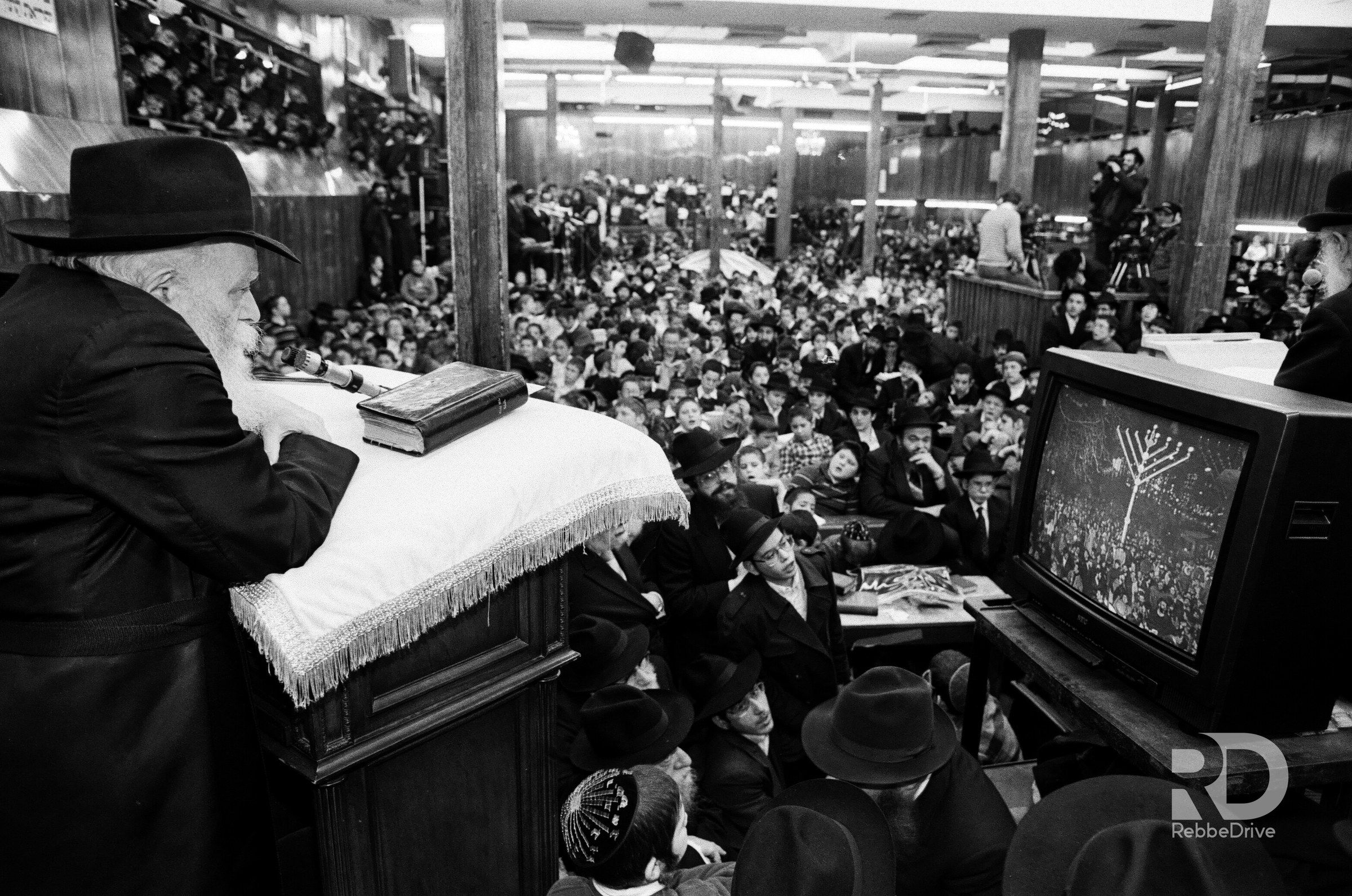
Chanukah with the Rebbe
Kislev 5734, weeks after the Yom Kippur War, as the Rebbe launches the first worldwide Chanukah campaign. Scenes in 770 from the diary of a yeshivah student, Reb Saadya Maatuf.
The Light in the Window
A band of partisans fleeing across a frozen border takes shelter in a guard's hut. The old rabbi they almost left behind lights his menorah in the window.
A Chanukah Adventure
On his way to hand out menorahs on Long Island, a young teacher is pulled over for speeding. The officer turns out to be Jewish, and a traffic stop becomes an invitation.
The Meaning of the Chanukah Lights
The Previous Rebbe told his Chassidim to listen to what the candles are saying. The Rebbe reads their message in the laws of the mitzvah: light the dark outside, use none of it, and add more every night.
Sichos in English