Chanukah and Moshiach
Moshiach is never named in the Chanukah story, its blessings or its prayers. Scratch the surface, though, and every part of it points to him: the battles, the rededicated Beis Hamikdash, the lit Menorah and the number eight.
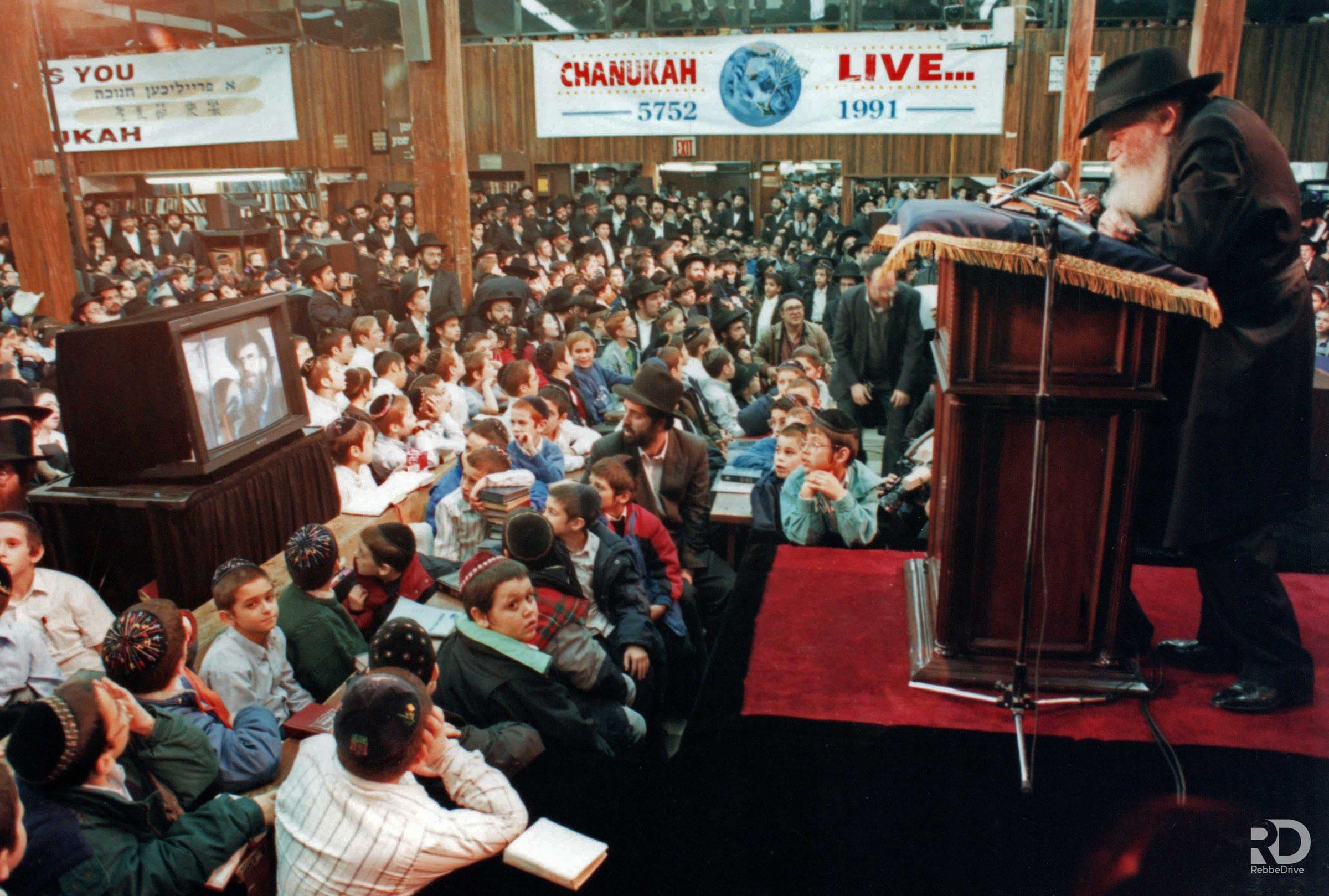
Scratch the surface of a table and you find out whether it is solid wood or veneer. Scratch the surface of a pair of shoes and you learn whether they are leather. Scratch the surface of Chanukah, a L’Chaim essay suggests, and you find out what it really is: Moshiach.
Moshiach is not named anywhere in the Chanukah story. He does not appear in its customs, its blessings or its prayers. But retell the story and see.
The story, retold
The Jewish people lived under Greek rule. The Greeks pressed them to give up their ways, decreed against the Torah and desecrated the Beis Hamikdash, the Holy Temple. Many Jews were content to take on the Greek way of life. Then Matisyahu, a learned leader of the people, called on his brothers to fight G-d’s battle: “Whoever is for G-d, with me.” His small army fought under a banner bearing the verse Mi chamocha ba’eilim Hashem, “Who is like You among the mighty, O G-d?”, whose Hebrew initials spell Maccabee. Against all odds they defeated their enemy, purified and rededicated the Beis Hamikdash, relit the Menorah, and the people renewed its bond with G-d and the Torah.
Now set that beside what the Rambam (Maimonides) writes about Moshiach.
Moshiach will fight the battles of G-d. So did Matisyahu and his sons.
The only difference between this world and the days of Moshiach is that the Jewish people will no longer be subject to foreign rule. The Maccabees threw off the rule of the Greeks, at least for a time.
Moshiach will build the Beis Hamikdash. When the Maccabees purified and rededicated it, it was as though they had rebuilt it, since in its desecrated state it could not be used.
In the days of Moshiach the service of the Beis Hamikdash will be restored in full, including the lighting of the Menorah, as the Maccabees lit it.
The world will be filled with the knowledge of G-d, and people will seek to know Him. That is exactly what the Jews of Chanukah did when they renewed their commitment to G-d and His Torah.
Why should Chanukah, or anything at all, turn out to be about Moshiach underneath? Because the purpose for which the whole world was created is the perfect state it will reach when Moshiach comes.
Reliving the miracles
“These days are remembered and done,” says the Megillah of Purim, and Jewish teaching applies the same idea to every festival. A festival is not only a memory of something long ago. Each year, on its anniversary, the same spiritual energy returns to the world, and we can draw on it.
On Chanukah, a small band of Jews devoted heart, body and soul to G-d defeated the strongest army of the day. Each Chanukah we can draw on that same devotion and take on a mitzvah we have long wanted to keep.
The oil carries its own lesson. There was other oil to be had; the Greeks had tampered with it, and halacha would have allowed it. The Maccabees would not compromise on the rededication of the Beis Hamikdash. Their resolve gives us strength to keep our mitzvos without compromise too, whether that means a few coins in a charity box each day, a kind word to a lonely person, a mezuzah on a doorpost or time set aside for Jewish learning.
In the blessing over the lights we thank G-d for miracles “in those days, at this time.” On Chanukah we can expect miracles in our own days too, leading up to the greatest of them all: the peace, plenty, health and Divine wisdom that the whole world will know in the days of Moshiach.
Eight, and the miraculous
Chanukah lasts eight days, and in a number of sources the number eight is tied to the era of Moshiach. Kabbalah explains the link: seven is the number of the natural order, while eight belongs to what lies beyond nature, the miraculous. The eight days of Chanukah are days of miracles, and the coming of Moshiach too will be a time of miracles, as the prophet says: “As in the days of your going out of Egypt, I will show them wonders.”1
What the lights prepare
HaGeula draws together several of the Rebbe’s talks on what Chanukah looks like in the light of the Geulah.2
The lights recall the spiritual victory over the Greeks, who sought to defile the holiness of the Torah and its mitzvos. In the Geulah their meaning will deepen: they will stand above all for the full and lasting revelation of G-dliness in the world, as Yeshayahu says, “The glory of G-d will be revealed, and all flesh together will see.”3 The Rebbe Melech HaMoshiach explains that oil, which stands for a wisdom above nature, represents the Torah of Moshiach, the inner dimension of the Torah that will be revealed in the Geulah. The Chanukah lights are a preparation for that revelation.
The law that the lights are “a light for a man and his household” places the mitzvah in the Jewish home, where holiness begins before it spreads outward. In the Geulah the Jewish home reaches its fullest meaning, when the whole world becomes a dwelling place for G-d. The light added each night, rising steadily in holiness, will then reach its completion.
Publicising the miracle prepares the world for the day when “the earth will be filled with the knowledge of G-d.”4 The light that goes out from the Chanukah menorah is a picture of the light of Moshiach, which will shine for all the nations.
Above all, the Rebbe stresses again and again that Chanukah prepares us for the Geulah, and that our small deeds, lighting the menorah, educating our children and spreading word of the miracle, are the links that bind us to a Redemption that is very near.
Footnotes
Sources
- L'Chaim (Sichos in English), Chanukah: Just Scratch The Surface.
- L'Chaim (Sichos in English), Chanukah: Reliving Chanuka.
- HaGeula, חנוכה לאור הגאולה: מהותו ותפקידו.
Adapted from L'Chaim and, in translation, from HaGeula.
Related
Looking for Moshiach in Chanukah
A person who yearns for Moshiach every day naturally finds him everywhere, the Rebbe said. Seen with 'Moshiach eyes', Chanukah, Parshas Mikeitz and the Haftorah of the Menorah all point to the Third Beis Hamikdash.
Chanukah in the Time of Geulah
Will we still light Chanukah candles when Moshiach comes? The authorities who say no, the Ramban and the Rebbe who say yes, and how the lights may be kindled then, counting down as Beis Shammai taught.
HaGeulaThe Light of the Third Beis Hamikdash
Chanukah is the festival of a rededicated Beis Hamikdash, and every year it stirs the longing for the next one. What the Menorah's light was for, what the Chashmona'im knew in their darkest hour, and the light the Third Beis Hamikdash will bring.
HaGeulaThe Oil of Torah: A Teaching from Dvar Malchus, Mikeitz 5752
Every festival is marked with a meal; Chanukah is marked with oil. In a talk of Shabbos Mikeitz 5752, the Rebbe explains why, and how the oil of Chanukah leads to Moshiach, 'the anointed one'.
Dvar Malchus 770Why Eight Days?
The oil was enough for one night, so the miracle lasted seven. Why, then, does Chanukah last eight days? The classic answers, and what the number eight points to.
Sichos in English