The Oil of Torah: A Teaching from Dvar Malchus, Mikeitz 5752
Every festival is marked with a meal; Chanukah is marked with oil. In a talk of Shabbos Mikeitz 5752, the Rebbe explains why, and how the oil of Chanukah leads to Moshiach, 'the anointed one'.
In 5751 and 5752 (1990–1992), the Rebbe Melech HaMoshiach’s Shabbos talks were edited and published week by week. The collection is known as Dvar Malchus, “the word of the King,” and its theme from beginning to end is the Geulah, the Redemption. The talk of Shabbos Parshas Mikeitz 5752, which fell during Chanukah, begins with a simple question about oil.
A festival of oil
Chanukah commemorates, and makes known, the miracle of the oil that burned for eight days. Oil is an unusual food. It is edible, but nobody eats it on its own. We add it to other foods and it makes them better; by itself it does a person harm.
Every other festival, Purim included, which resembles Chanukah in many ways, is celebrated with a festive meal of bread, wine and water. Why is Chanukah marked with oil instead?
Bread, wine and oil
Each of these is a metaphor for the Torah, the Rebbe explains, and each for a different part of it.
Bread and water are the basics of life. Without them a person cannot live. They stand for the revealed Torah, the part a Jew needs in order to know how to keep the mitzvos.
Wine is a luxury. One can live without it, but it brings joy and enthusiasm to a meal. It stands for the secrets of the Torah.
Oil is not a necessity either, and it is taken only in tiny amounts added to other food. It stands for the “secret of the secrets” of the Torah.
Chanukah is marked with oil because it was the first step in revealing pnimiyus haTorah, the inner dimension of the Torah. That oil was first “pressed from the olives” through the self-sacrifice of the Maccabees as they stood firm against the Greeks and their Hellenist supporters, who would accept only the most superficial view of the Torah.
The oil is commemorated with lights, not with eating. Yet the Jewish custom of eating foods fried in oil, latkes and sufganiyos (doughnuts), shows a desire that grew in later generations: to take this part of the Torah inside oneself.
The oil revealed, step by step
From then on, the “oil” of Torah came out into the open more and more. First came Rabbi Shimon bar Yochai and the Zohar; then the teachings of the Arizal; then the Baal Shem Tov and Chassidus; and then Chassidus Chabad, which presents the inner dimension of the Torah in a way that can be “eaten” and absorbed, not only looked at like a flame.
That steady unfolding is bound up with Moshiach. The word Moshiach itself means “anointed,” anointed with oil.
A necessity in our time
Oil can be burned to give light in the dark. As the darkness of exile deepens, more oil is needed, which means more study of the inner dimension of the Torah. In these final moments of exile, when the darkness is greatest, the need is greater than ever, to the point that the Rebbe says that the oil is now a necessity. In the fight against darkness, the inner dimension of the Torah is needed even more than its revealed part.
Yet the darkness is not the main reason the oil is being revealed now, on Chanukah and even more on Yud-Tes Kislev, the anniversary of the Alter Rebbe’s release from prison. The main reason is that we are coming ever closer to the coming of Moshiach, who is called Moshiach because he is anointed with oil, and through him will come the full revelation of the “secret of the secrets” of the Torah. The main study in the days of Moshiach, the Rebbe notes, will be the inner dimension of the Torah. As the Alter Rebbe writes in the Tanya, in that time Jews will know the foundations of the revealed Torah through its inner dimension.1
Why the darkness grows stronger
The Rebbe adds that the nearness of Moshiach also explains why the darkness has grown stronger. When holiness grows stronger, the forces that oppose it grow stronger too, and they set themselves against the coming of Moshiach. They must be fought, and that is the sense of the Rambam’s words that Moshiach “will fight the wars of G-d” until he is victorious.
Those wars are fought by “the soldiers of the house of David.” In recent generations, the Rebbe says, that was the purpose for which the Rebbe Rashab founded the yeshivah Tomchei Temimim. Its students go out against “those who scoff at the footsteps of Your anointed one,” and they prevail, bringing about the revelation of David, the King Moshiach. And especially in our generation, the Rebbe says, everything has already been completed, and all that remains is to open our eyes and see that “behold, he comes.”
Mikeitz: the end and the beginning
The Rebbe ties the two reasons, the deepening darkness and the approaching Geulah, to two meanings of the word keitz, the “end” that gives Parshas Mikeitz its name: keitz hayamim, the end of the days of exile, and keitz hayamin, the end that is really the beginning of the “right side,” the Geulah.
He reads the whole run of Torah portions of these weeks, from Vayeishev to Vayechi, as a story of Geulah. Vayeishev Yaakov: Yaakov sought to settle in peace, the final peace of the days of Moshiach, because for his part he was already ready for it. The sequence ends with Vayechi, “and Yaakov lived,” which speaks of the eternal life of Yaakov in the time of the resurrection of the dead, and with him every Jew, who is called Yisrael after him.
Even in Egypt, in what were called Yaakov’s best years, he and his children were not satisfied, though Pharaoh had given them the best of the land. What mattered to them was the Geulah. The time in Egypt, the Rebbe says, was only for the sake of bringing the final Geulah, which through the refinement of Egypt would come in a loftier and more complete way.
The lesson
The Rebbe concludes that we must strengthen our faith in, and our waiting for, the coming of Moshiach, until a person feels that as long as Moshiach has not actually come, in a revealed way, his days are lacking. And above all, we should add in the study and spreading of the inner dimension of the Torah, the oil of the Torah, in a way that it lights up the outside, like the Chanukah lights.
So we reach the time the Rambam describes, when “all the fasts will be nullified in the days of Moshiach,” and more than that, will become festivals and days of joy.
The Rebbe notes the Rambam’s exact wording, “nullified to the days of Moshiach.” It may mean that the fasts will not be cancelled at all, but rather outshone: the great revelations of that time will eclipse them without changing them, the way a candle is lost in the blaze of a bonfire. This fits the explanation in Chassidus of the Sages’ teaching that in the future the festivals will be “nullified”: not abolished, since they are part of the Torah, but surpassed by the greater revelations of Moshiach.
Footnotes
-
Tanya, Iggeres HaKodesh, ch. 26. ↩
Sources
- Dvar Malchus 770, Miketz-Chanukah 5752: Oil and the Anointed One.
- Living With Moshiach (Torah4Blind), "Dvar Malchus" Parshat Mikeitz, 5752.
Adapted from the English summary at Dvar Malchus 770 of the Rebbe's talk of Shabbos Parshas Mikeitz 5752.
Related
Chanukah and Moshiach
Moshiach is never named in the Chanukah story, its blessings or its prayers. Scratch the surface, though, and every part of it points to him: the battles, the rededicated Beis Hamikdash, the lit Menorah and the number eight.
L'Chaim (Sichos in English)
Looking for Moshiach in Chanukah
A person who yearns for Moshiach every day naturally finds him everywhere, the Rebbe said. Seen with 'Moshiach eyes', Chanukah, Parshas Mikeitz and the Haftorah of the Menorah all point to the Third Beis Hamikdash.
The Light of the Third Beis Hamikdash
Chanukah is the festival of a rededicated Beis Hamikdash, and every year it stirs the longing for the next one. What the Menorah's light was for, what the Chashmona'im knew in their darkest hour, and the light the Third Beis Hamikdash will bring.
HaGeulaWhy Do We Celebrate the Miracle of the Oil?
Chanukah had two miracles, a victory in battle and the oil that burned eight days. The Sages built the festival around the oil. The Rebbe explains why, and what it says about body and soul.
Sichos in English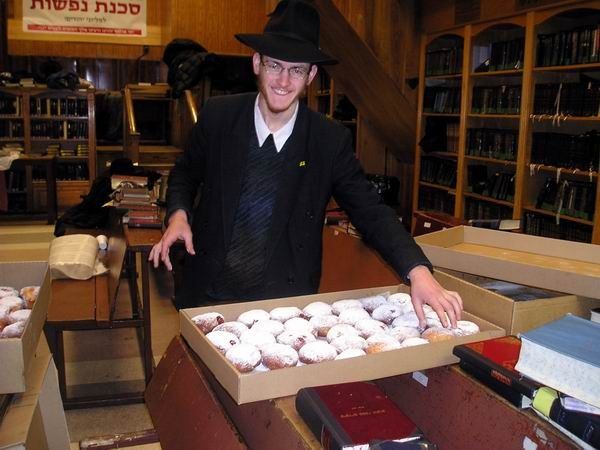
Traditional Chanukah Foods
Why we eat latkes, sufganiyos and dairy foods on Chanukah, festive meals, and the right blessings on latkes and doughnuts.