The Significance of Chanukah Gelt
Chanukah is the most spiritual of festivals, and its best-loved custom is giving money. A Chassidic look at why the light of Chanukah reaches even our coins.
Chanukah celebrates a spiritual victory. The war with the Greeks was, at its root, a war over ideas: the Greek outlook that put the physical first, against the Torah and its mitzvos. The Levush, a classic commentary on Jewish law quoted by many later authorities, explains that for this reason Chanukah is not celebrated with feasting the way Purim is. On Purim the Jews’ bodies were in danger and were saved. On Chanukah it was mainly the soul that was threatened, and the soul that benefited from the miracles.
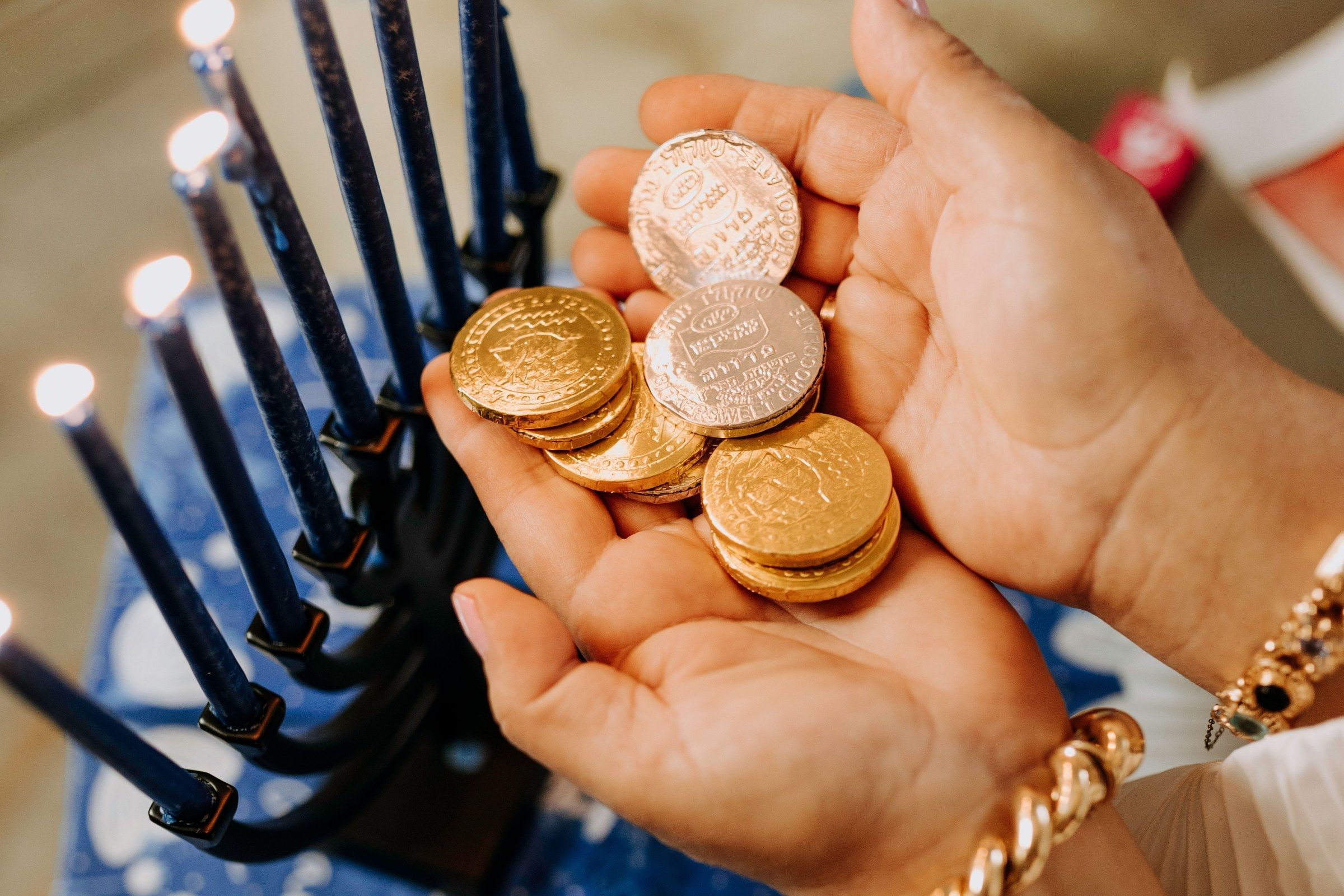
So we celebrate with extra prayers, with Hallel, and with the lights of the menorah. Also with dreidel and jelly doughnuts. And with Chanukah gelt.
That last one is strange when you think about it. Here is the most spiritual of festivals, and its favourite custom is handing out money, which is usually seen as the very opposite of spirituality. The Sages gave a title of special holiness to Rabbi Menachem ben Simai precisely because he would not even look at a coin. On Purim, at least, the gifts of food have a ready explanation in love and unity among Jews. Where is the service of G-d in giving out cash, and why on Chanukah of all days?
Fourteen cents
Rabbi Akiva Wagner, writing in Beis Moshiach, answers with a story.
Rabbi Mendel Wechter was an influential educator in Satmar who began attending the farbrengens, the Chassidic gatherings, of the Rebbe Melech HaMoshiach. Being seen in Lubavitch would have been very dangerous for him, so he would watch from a small opening in the wall of an upstairs room in 770, unseen.
One day, before a farbrengen that evening, Rabbi Wechter was visiting a dayan (rabbinic judge) in Satmar. As he was leaving, the dayan stopped him to return fourteen cents he owed him in change. Rabbi Wechter waved it away as too small to matter. The dayan disagreed: with fourteen cents, he said, a man can betroth fourteen women.
That night, in the middle of a talk, the Rebbe remarked that a person may find fourteen cents and think them of no importance. He is wrong, the Rebbe said. With those fourteen cents he can give tzedakah, charity, fourteen times, and that is fourteen connections with G-d Himself.
Money in its true light
Money is commonly thought of as the opposite of holiness. It is not evil in itself. It is one more means by which a person connects with G-d Himself, because at its core it too is part of the way G-dliness shows itself in the world. Most of the time we do not see that. We see the greed and the strife that money can bring.
Chanukah gives powers that the rest of the year, and even the other festivals, do not. On Chanukah we put the menorah outside, at the door, because we are given the strength to light up the darkness itself. The aim is not only to add light until darkness retreats. It is to show what the darkness truly is, that deep down it is light.
Seen by that light, money is not the root of greed. It is a tool for the strongest connection with G-d. So it is natural that on Chanukah we give gelt. On Chanukah, when we can turn the darkness itself into light, the money is no longer “worthless gelt” or the gelt of the evil inclination. It is Chanukah gelt. The light of the menorah shows what it really is.
Gelt and the Geulah
Usually we can see purity and G-dliness only in things that are bright by nature. Chanukah gives us the ability to see past the outer coverings, and to recognise the world itself, and everything that stands for it, as a vehicle for G-d’s presence to be revealed here below.
That is why Chanukah is so closely tied to Moshiach, whose days are associated with the number eight. The Geulah, the Redemption, brings nothing foreign into the world. It reveals what was always true: that G-d is One and His Name is One, and that this is visible in the world itself.
The preparation for it is the work of Chanukah: lighting up what is outside, the darkness and the world, by showing that even something as ordinary as gelt is part of G-d’s plan. The Midrash says gold was created for the Mishkan, the Sanctuary in the desert, and the gelt of Chanukah belongs to that same story of dedication, the dedication of the Mishkan, of the Beis Hamikdash, and of the Third Beis Hamikdash still to come. And it is part of chinuch, the education of our children, a word that shares its root with Chanukah.
Rabbi Wagner closes his farbrengen with a blessing in the same spirit: that as we give Chanukah gelt to our children, students and friends, G-d will give His children their Chanukah gelt too, in plenty, and above all the long-awaited gift of the complete revelation of Moshiach, now.
Sources
- Rabbi Akiva Wagner, Beis Moshiach, no. 859 (December 6, 2012), Why Chanuka Gelt?!.
Adapted from a farbrengen by Rabbi Akiva Wagner in Beis Moshiach, no. 859.
Related
Chanukah Gelt
The custom of giving children money on Chanukah: its reasons, when and how the Rebbe encouraged giving it, coins or notes, tzedakah, and the Shabbos dates this year.
The Meaning of the Chanukah Lights
The Previous Rebbe told his Chassidim to listen to what the candles are saying. The Rebbe reads their message in the laws of the mitzvah: light the dark outside, use none of it, and add more every night.
Sichos in EnglishThe Secret of Chanukah
The decrees, the self-sacrifice and the miracles of Chanukah were all above reason. The Rebbe explains how that makes Chanukah a blueprint for Jewish life.
Sichos in EnglishChanukah and Moshiach
Moshiach is never named in the Chanukah story, its blessings or its prayers. Scratch the surface, though, and every part of it points to him: the battles, the rededicated Beis Hamikdash, the lit Menorah and the number eight.
L'Chaim (Sichos in English)