The Menorah in Union Square
A San Francisco lawyer who has not lit a menorah in fifteen years takes his daughter to a public lighting in Union Square. A hostile stranger pushes toward the torch.
When Boruch Bush was a boy, Chanukah meant his family standing quietly in the living room before the menorah. Each night of the eight they lit the candles and said the blessings, and remembered the Maccabees. In Sunday school he learned that the menorah meant that right can overcome might and light can drive away darkness. He and his brother took turns lighting. A room full of light, a family full of warmth: that was Chanukah.
That was many years ago. Since then he had become a lawyer and a community worker and had drifted far from any Jewish practice at all. He had not lit a menorah in years. He had hardly thought about one. Yet lately he had begun to feel a need to look for his Jewish roots. Perhaps that was why, one cold December night, he found himself walking with his family toward Union Square in San Francisco. They were going to see a menorah lit, and not an ordinary menorah. This one was thirty feet tall.
The square
They arrived at about four. The square was cold and nearly empty, and the street people had claimed the benches. It was a let-down. Then he saw some movement, and there it was. He pointed it out to his daughter, Sarah. As they came closer the menorah grew taller, until they stood beneath it looking up at its simple, elegant shape. It fit the square well after all.
In the corner was parked a camper painted with the words “Mitzvah Mobile” and “Chabad House.” The menorah was the work of the Chabad House in Berkeley. These Lubavitchers, he knew, believed in sharing Jewish life with every Jew, the very religious and the not at all religious. That was why they were here. It was also why he, who had not so much as seen a menorah in more than a decade, was a welcome guest.
Before he knew it, a tall young man in a black hat and long coat, with a bright red beard, had him in a bear hug. “Shalom aleichem! Welcome, brother!” This was Yosef Langer, one of the organisers.
The man in the leather coat
There was time before the lighting, so they sat and waited. Beyond the little circle around the menorah, the square still belonged to the night and its regulars. Some of them wandered over to look at the strange newcomers, and it was not altogether comfortable. One man was openly hostile. Tall, a long black leather coat over his shoulders, he paced back and forth announcing loudly what he thought of this event, and of Israel, and of Zionists, and of Jews. None of it was kind. A wave of city fear passed over Boruch. This was not the warm picture he had carried in his head.
What are we doing here? he wondered. Isn’t this the kind of thing that belongs at home, by the fireside, the family gathered in the living room? In the middle of Union Square?
When he looked up again, the square had filled. The little circle of three quarters of an hour before had spread across half of it. Four generations stood there, chatting with friends and with strangers who were quickly becoming friends. It took the man at the microphone, black hat, black beard and a broad smile, a full five minutes to get their attention. This was Rabbi Chaim Drizin. He said a few words about the Chabad House and about Chanukah, and told a story with a lesson in it. When he finished, the crowd applauded, and somehow the story had drawn everyone closer. The square felt homely. Almost like a family. Perhaps, Boruch thought, this is my childhood living room after all, only with a much bigger family.
The torch
Now Yosef, the red-bearded man, waded into the crowd holding high a burning torch, so that each person could touch it and have a share in the lighting. He moved slowly, letting each one reach out. Parents lifted children up. Nobody pushed; everyone was sure of a turn. Boruch lifted Sarah, and for a moment she put her hand beside Yosef’s.
Rabbi Drizin began to sing, and the crowd sang with him: Shema Yisrael, “Hear, O Israel, the L-rd is our G-d, the L-rd is One.” The words matched what the torch was doing, joining all these Jews of every age and type, language and background, to one another and to their faith.
Then Boruch saw a man pushing through the crowd toward Yosef. It was the man in the leather coat. Boruch felt himself go tight. Did he mean to stop Yosef? To grab the torch? It seemed mad, but who could tell?
The man reached Yosef’s side. His face gave nothing away. He reached up and took hold of the torch, not touching it but gripping it hard. Yosef stopped.
And then, Boruch saw very clearly, Yosef looked straight into the man’s eyes, laid his other hand gently on the man’s arm, and gave a small, quiet nod. Recognition. A silent request for respect, each for the other. It took a few seconds. The man’s grip loosened. Yosef moved on. The man drifted back to the edge of the crowd, and when Boruch looked for him a little later, he was singing.
That moment stayed with him all evening, and it seemed to draw everything he had felt that night together. This, he thought, was what Chanukah was about: a small band of Maccabees defeating great armies, a little oil lasting eight days, light pushing back the darkness. And perhaps behind every moment when light drives back darkness there is a lifetime, a generation, an age of patient work, building knowledge and awareness and inner strength, until, when the moment comes, the Divine spark that is always hidden in us and around us bursts out into the open.
Yosef finished his round and handed the torch to Rabbi Drizin, who climbed into a cherry picker and was lifted to the top of the menorah. The blessings were said, and the first light of the first night of Chanukah was lit.
That night, for the first time in fifteen years, there was a menorah in Boruch Bush’s home. He and Sarah lit it together and set it in her window, to shine out into the dark. They would do it again the next year, too. As the Chassidic saying goes, you can’t chase away darkness with a stick.
Sources
- Boruch Bush, L'Chaim Weekly (Sichos in English), reprinted from the San Francisco Chronicle, Chanukah: The Menorah in Union Square.
Retold from Boruch Bush's account in the San Francisco Chronicle, reprinted in L'Chaim.
More Chanukah stories
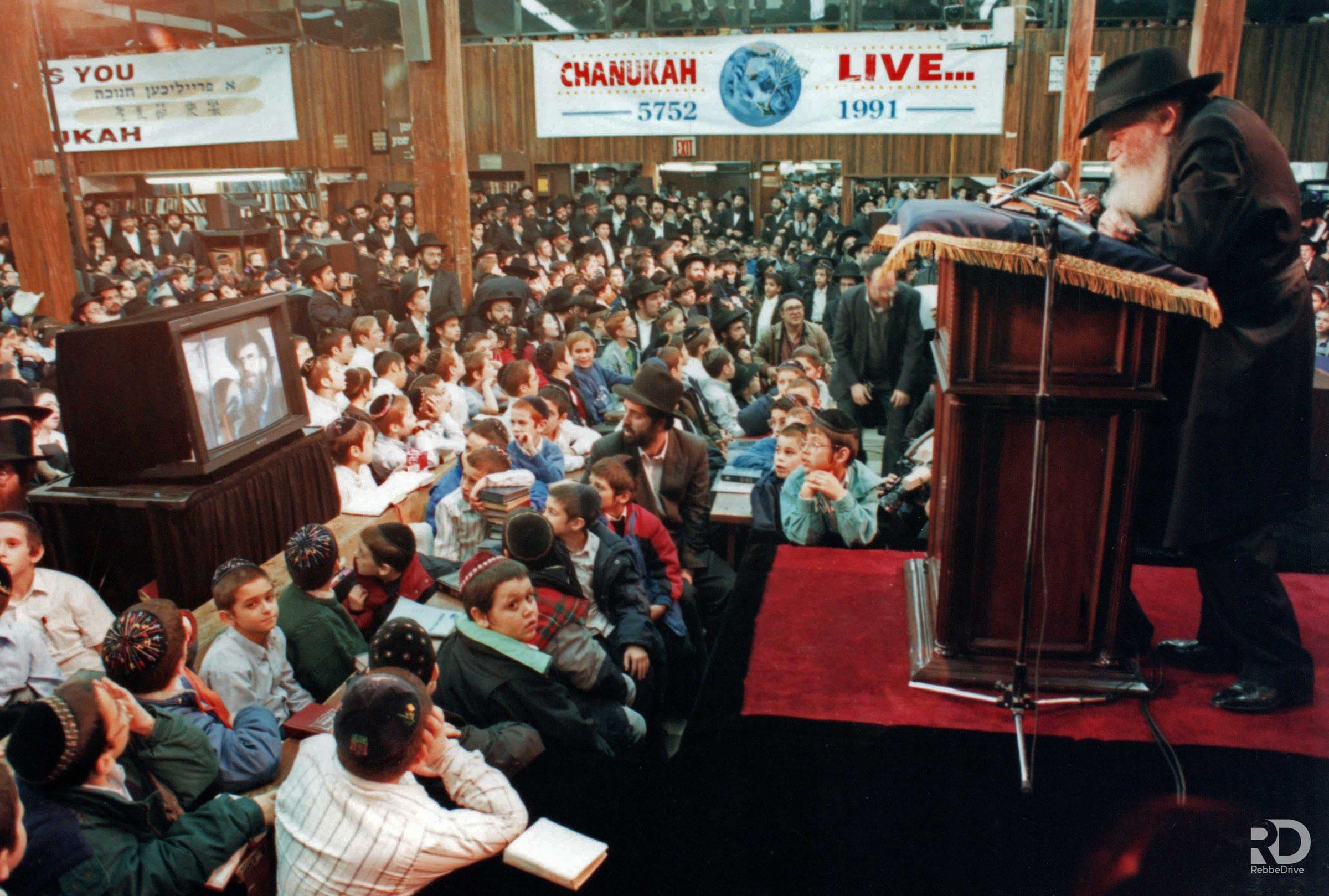
The Rebbe's Chanukah Campaign
Why the Rebbe Melech HaMoshiach set out to bring a menorah into every Jewish home and into the public square, what he asked of every Jew during Chanukah, and how the campaign connects with the Geulah.
A Chanukah Adventure
On his way to hand out menorahs on Long Island, a young teacher is pulled over for speeding. The officer turns out to be Jewish, and a traffic stop becomes an invitation.
A Shout in the Corridor
After a night handing out doughnuts and menorahs to soldiers on the Egyptian border, Reb Moshe Simon almost skips the empty field hospital. Something tells him to go.
Where to Place the Menorah
Doorway or window, left side or right, how high and which room: where the Chanukah menorah goes, with the halacha, the general custom and the Chabad custom.